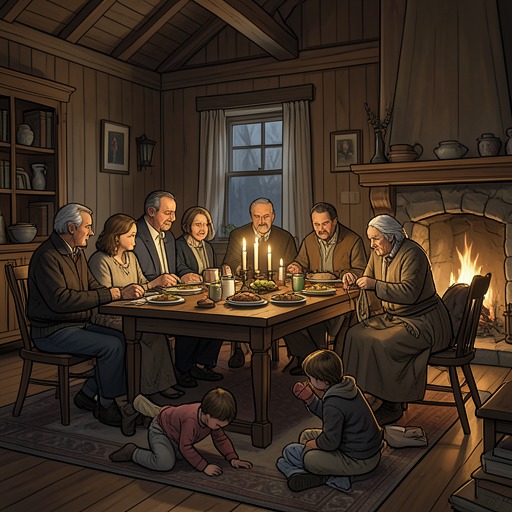
Princess Marya Bolkonskaya
War and PeacePrincess Marya Bolkonskaya is the daughter of Prince Nikolai Bolkonsky and the sister of Prince Andrei Bolkonsky. Her decisive significance lies in the tension between an apparently plain, frightened, and submissive exterior and a powerful inner life governed by faith, duty, compassion, and self-command. Her story moves from confinement at Bald Hills, through the shock of war and her father’s death, toward a cautious reawakening of personal hope and a mature willingness to assume responsibility for others.
Identity and Life at Bald Hills
Princess Marya lives at Bald Hills with her father and her companion, Mademoiselle Bourienne. Prince Nikolai Bolkonsky has remained on the estate despite being free to return to Moscow or Saint Petersburg, insisting that anyone who wishes to see him may make the journey to Bald Hills. The household follows his strict routine and reflects his principles: he regards idleness and superstition as the chief sources of vice, and activity and intelligence as the corresponding virtues. Within this ordered but oppressive environment, Marya is described as having a sad, frightened expression that rarely leaves her face, while her untidiness contrasts with her father’s relentless tidiness.
Her education is conducted under her father’s authority, especially through mathematics. He gives her geometry and tells her that mathematics will drive nonsense from her head, treating intellectual discipline as a form of moral training. Yet his hostility toward religion creates the deepest wound in their relationship. When he sees a religious book sent by Julie Karagina, he says that he does not interfere with anyone’s belief but dismisses the volume. Marya returns to her room troubled, though she continues to hope that her father’s attitude may soften; she has noticed that his satire has recently become less bitter and that he once received a monk for a long conversation.
Family Duty and Religious Conviction
Marya’s devotion to her father is not merely obedience. When Prince Andrei Bolkonsky asks whether their father’s harshness makes life difficult for her, she reacts with shock and rejects the idea that he can be judged in ordinary terms. She insists that, whatever his faults, he inspires veneration, and she declares herself content and happy with him. Her one profound unhappiness is his treatment of religious subjects: she cannot understand how a man of such immense intellect can fail to recognize what seems clear to her faith.
Her religious feeling is active rather than ornamental. She prays for her father’s spiritual improvement and asks Prince Andrei to help her, holding something in her reticule and hesitating before revealing the favor she wants from him. Her faith gives her a language of hope, but it also demands self-scrutiny. During her father’s illness, she is horrified to discover that part of her longs for his death. The recognition fills her with loathing for herself, even as exhaustion and fear surround the sickroom. Her moral seriousness appears precisely in her refusal to excuse the thought or conceal its implications from herself.
Marriage, War, and the Loss of Her Father
When Prince Vasili Kuragin brings Anatole Kuragin to Bald Hills, the visit has a matrimonial purpose. Prince Nikolai explains to Marya that Anatole has been presented as a possible husband and leaves the decision to her, though his own disapproval is evident. Marya says that she wishes only to do her father’s will, but the old prince’s cruel joke about Anatole taking Mademoiselle Bourienne as his real wife exposes the humiliation and insecurity surrounding the proposal. The episode shows how little freedom Marya feels she possesses: even the expression of a personal desire is mediated through obedience to her father and fear of his judgment.
Her father’s final illness transforms that dependence into a crisis of conscience. When the doctor tells her that Prince Nikolai is slightly better and is asking for her, Marya experiences terror and joy together. She enters the room to find him physically diminished, his face shriveled, his features reduced, and his speech damaged. He presses her hand because he has been waiting for her, then struggles to form words while looking at her timidly and imploringly. The scene reverses their ordinary relation: the commanding father becomes small and dependent, while Marya must supply the patience and tenderness that communication now requires.
After his death, Marya’s private grief becomes inseparable from the catastrophe of Russia. She travels to Moscow with her nephew, receives instructions from Prince Andrei about reaching her aunt, and tries to occupy herself with practical arrangements, a new household, and the child’s education. Her anxiety for her brother and her sense of incompetence as an educator coexist with a deeper peace produced by the suppression of personal hopes. She feels that she has stifled the dreams awakened by her meeting with Nikolai Rostov, as though mourning and duty have temporarily sealed off the possibility of happiness.
Rostov’s Rescue and the Reawakening of Hope
At Bogucharovo, Marya is trapped by the peasants after her father’s funeral. They refuse to let her depart, threaten to unharness the horses, and claim that an order forbids movement. Dron has surrendered the keys and joined the crowd, while Karp speaks for the peasants. When cavalrymen approach, the household initially mistakes them for Frenchmen; the coachman runs away, and the women begin to wail.
Nikolai Rostov arrives with Ilyin and finds Marya helpless and bewildered in the sitting room. His first impression is intensely romantic: he sees a grief-stricken woman abandoned to coarse rioters, yet he also recognizes gentleness and nobility in her features and expression. Marya recognizes him as a Russian and as a man of her own class, then tells him what has happened in a trembling voice. When she mentions that the crisis followed the day of her father’s funeral, she turns away, afraid that her words may seem designed to arouse pity. Rostov is moved to tears and offers his word of honor that no one will trouble her if she allows him to escort her. His intervention restores her freedom of movement and creates a bond that neither of them can treat as merely practical.
In Voronezh, however, the possibility of love becomes a source of disturbance rather than immediate consolation. The governor’s wife praises Rostov and reports that he blushes when Marya’s name is mentioned, while Marya’s aunt approves of bringing the young people together even though a formal betrothal is impossible under present conditions. Instead of feeling uncomplicated joy, Marya experiences renewed desire, doubt, self-reproach, and hope. She considers whether her mourning makes it improper to receive Rostov, then worries that refusing him would be rude after his service to her. The episode reveals how strongly she disciplines her own feelings, treating love as something that must be morally examined before it can be accepted.
Later Conduct and Moral Responsibility
Marya’s later actions remain connected to a wider network of family obligation. The Rostovs’ financial decline has become severe: their debts increase during their years at Otradnoe, and the old count travels to Saint Petersburg seeking official employment. After Count Ilya Rostov dies, Nikolai Rostov learns that the debts are twice the value of the property. He refuses to reject the inheritance because he regards doing so as an insult to his father’s memory, accepts the debts, receives thirty thousand rubles from his brother-in-law Pierre Bezukhov toward obligations he considers genuine, and returns to government service to avoid imprisonment.
When Marya comes to Moscow and hears that Nikolai has sacrificed himself for his mother, she feels a joyful confirmation of her love and decides that duty requires her to visit the family. Yet Nikolai receives her with a cold, stiff, proud expression instead of the pleasure she expected. He takes her to the countess, leaves after five minutes, and later escorts her to the anteroom with marked solemnity. His withdrawal does not erase the relationship created at Bogucharovo; instead, it places their emotional future under the pressure of shame, debt, mourning, and his determination to preserve his family’s honor.
Narrative Role and Significance
Princess Marya’s characterization joins personal feeling to the historical and social structures around her. Her father’s household turns education, religion, and family authority into daily tests of obedience. Her marriage prospects expose the restricted choices available to a woman whose future is negotiated by male relatives. War then removes the physical and social protections of the estate, forcing her to confront peasants, military power, bereavement, and displacement. Her response is neither rebellion nor passive surrender: she preserves compassion and moral agency within circumstances that repeatedly deny her independence.
Her narrative is also shaped by contrasts. She is intellectually trained by a father who mocks the religious belief that gives her life meaning. She appears timid, yet she endures the most intimate demands of illness and death. She suppresses her hopes after meeting Rostov, yet those hopes return as soon as others speak his name. And when she visits the impoverished Rostovs, her tenderness meets Nikolai’s defensive pride. Through these reversals, Princess Marya becomes a figure of inward development: her strength is not the absence of fear or desire, but the ability to acknowledge both and still act from responsibility, faith, and love.